
The other "greatest" Hamlet of the last half of the twentieth century was, according to some critics, Nicol Williamson's. It become so famous that he was invited to perform a one-man show for Richard Nixon at the White House, a circumstance that gives rise to multiple ironies, since Hamlet is a play full of spying, overheard conversations, and advice to be true to oneself given by self-deceivers. At any rate, the movie version of Williamson's Hamlet was filmed at the Roundhouse in London and directed by Tony Richardson. It shaves the text to a minimum (reducing the Ghost to a brilliant light and a clangorous sound effect), but is nevertheless worth seeing, because Williamson's performance is special, and some of the other casting is daring and works.
Burton's Hamlet paved the way for more choleric Hamlets, angrier princes; Williamson's keeps some of the anger, but no actor quite combines that quality with Hamlet's nervous tension, and above all, his intelligence. Add to that the hint of a burr in Williamson's accent (most previous Hamlets sounding as if they had all been born in Mayfair), and the interiority that Richardson's close-ups evoke (especially in the soliloquies, where the actors address the camera directly), and Williamson's becomes a very personal Hamlet.
The interesting casting choices include one of Anthony Hopkins's earlier notable performances, as Claudius, and it doesn't seem to matter that in this case it is not the Gertrude who is too young, but the Claudius--Hopkins is only a year older than Williamson (further irony lies in the fact that Hopkins later played Nixon in Oliver Stone's movie). Hopkins's voice also still conveys a Welsh lilt. Gordon Jackson is another splendid Horatio, and Michael Pennington (who has written a fine book on Hamlet) is a solid Laertes. One of my favorite actors, Roger Livesey, he of the gravelly voice, plays both the first player and the Gravedigger. Several other actors double roles, thus giving a hint of the kind of performance a repertory company like Shakespeare's would give.
The gamble in casting, one which at first seemed a capitulation to the Zeitgeist, was having Marianne Faithfull play Ophelia, but she does a creditable job. Only here Richardson makes the questionable decision of implying that Laertes and Ophelia have an incestuous relationship--their kiss in Act 1 would probably prompt cries of "Get a room" from today's audiences--or at least one person who shows it in his classes. When Polonius reports to Claudius and Gertrude about Hamlet and Ophelia, they are depicted as granting a general levee in their bed, greasily eating a meal, with their large dogs on the blankets. It's as if Richardson wants to remind us that he directed the "lusty" Tom Jones.
The film is shot in color, and the costumes are traditional early seventeenth-century garb. It is a short Hamlet, less than two hours long, but Richardson decides to keep in the rarely performed scene where Polonius sends Voltemand to spy on Laertes, as well as the fourth soliloquy. The second and third soliloquies are transposed. Unfortunately, the movie is available on DVD only in Great Britain, and no decent stills seem available on the net. Still, it pops up on cable and satellite from time to time, and it's worth watching--within fifteen minutes you'll know if this Hamlet is palatable for you.
Showing posts with label Nicol Williamson. Show all posts
Showing posts with label Nicol Williamson. Show all posts
Wednesday, August 15, 2007

Tuesday, August 7, 2007
Acting
When I was researching my review of a biography of British playwright John Osborne, I found a DVD available in Britain of a film by Tony Palmer about Osborne. It arrived too late to be useful for the review, but I'm still interested in Osborne, and I finally got around to watching it last night. It contained interesting archival interviews with theater people like Kenneth Tynan and Tony Richardson, as well as interviews with Osborne himself and contemporary playwrights who have been influenced by him, such as David Hare.
But by far the most fascinating bits were filmed excerpts from Osborne's plays as they were performed in the theater. This included extensive color footage of Olivier in The Entertainer ("you'll be out by half-past, uh, half assed"), as well as Osborne himself and his wife at the time, Jill Bennett, in A Patriot for Me. The performances though that astounded me were those of Albert Finney in Luther and Nicol Williamson in Inadmissable Evidence. The were revelatory, unbelievably transformative.
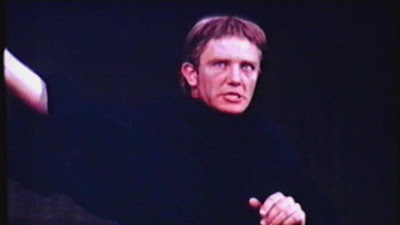
Take Finney's. His voice became deeper, his words seemed to be masticated and then spit out, his forearms corded and taut as his sleeves of his monk's gown kept rolling up. You could not take your eyes off him. I don't think this was merely due to the differences between acting on stage and in film. There is something about the transitory nature of dramatic performance that allows for this risk-taking; probably also the nature of film acting, with its breaks, pauses, and retakes, ameliorates the momentum a theatrical performace can build, especially with the long speeches Osborne gives his main characters.

Same effect with Williamson. His portrayal of Bill Maitland, a lawyer undergoing a breakdown, was riveting. In fact, this entry was going to be about what happened to Nicol Williamson's career, since at one point, to me, he had the greatest promise of any British actor. His Hamlet was original--barbed and acerbic--his Merlin suitably alien and chilling after the avuncular Merlin of Sword in the Stone, his Sherlock Holmes quirky and intelligent (the performance as well as the character). The IMDB mini-biography explains why his career kept self-imploding. He looked fine and was wickedly witty in his contemporary (2004) interviews in the film.
Interestingly enough, a film performance by Finney was also included in this documentary--his title role in Tom Jones, for which Osborne wrote the screenplay. And in it Finney seemed to be younger, less heavy, altogether lighter. Make-up was not the only explanation. He was acting, in the best British tradition. Olivier's Archie Rice is nothing like his Othello. Seems obvious, right?
Well, another movie extensively excerpted was Tony Ricardson's version of Osborne's Look Back in Anger, which stars Richard Burton as Jimmy Porter. And while I watched Burton's performance, I discovered that he really wasn't a very transformative actor at all. His Jimmy Porter is not all that different from his Hamlet. His voice is a magnificent instrument--to hear those soliloquies in the theater ("Frailty, thy name is wOMAN!") must have been thrilling. But he does the same vocal tricks with his Porter, modulating his voice and then jumping on a word (vIRGIN!"). Maybe he became a star too soon and didn't do enough repertory work, but he did not have all that much of a career to throw into the bottle when he finally did that.
But, as Finney said, it was Osborne's works at the Royal Court Theatre that gave him and other less "well-bred" actors opportunities to play leads in dramas instead of gardeners, and for that we can all be grateful.
But by far the most fascinating bits were filmed excerpts from Osborne's plays as they were performed in the theater. This included extensive color footage of Olivier in The Entertainer ("you'll be out by half-past, uh, half assed"), as well as Osborne himself and his wife at the time, Jill Bennett, in A Patriot for Me. The performances though that astounded me were those of Albert Finney in Luther and Nicol Williamson in Inadmissable Evidence. The were revelatory, unbelievably transformative.

Take Finney's. His voice became deeper, his words seemed to be masticated and then spit out, his forearms corded and taut as his sleeves of his monk's gown kept rolling up. You could not take your eyes off him. I don't think this was merely due to the differences between acting on stage and in film. There is something about the transitory nature of dramatic performance that allows for this risk-taking; probably also the nature of film acting, with its breaks, pauses, and retakes, ameliorates the momentum a theatrical performace can build, especially with the long speeches Osborne gives his main characters.

Same effect with Williamson. His portrayal of Bill Maitland, a lawyer undergoing a breakdown, was riveting. In fact, this entry was going to be about what happened to Nicol Williamson's career, since at one point, to me, he had the greatest promise of any British actor. His Hamlet was original--barbed and acerbic--his Merlin suitably alien and chilling after the avuncular Merlin of Sword in the Stone, his Sherlock Holmes quirky and intelligent (the performance as well as the character). The IMDB mini-biography explains why his career kept self-imploding. He looked fine and was wickedly witty in his contemporary (2004) interviews in the film.
Interestingly enough, a film performance by Finney was also included in this documentary--his title role in Tom Jones, for which Osborne wrote the screenplay. And in it Finney seemed to be younger, less heavy, altogether lighter. Make-up was not the only explanation. He was acting, in the best British tradition. Olivier's Archie Rice is nothing like his Othello. Seems obvious, right?
Well, another movie extensively excerpted was Tony Ricardson's version of Osborne's Look Back in Anger, which stars Richard Burton as Jimmy Porter. And while I watched Burton's performance, I discovered that he really wasn't a very transformative actor at all. His Jimmy Porter is not all that different from his Hamlet. His voice is a magnificent instrument--to hear those soliloquies in the theater ("Frailty, thy name is wOMAN!") must have been thrilling. But he does the same vocal tricks with his Porter, modulating his voice and then jumping on a word (vIRGIN!"). Maybe he became a star too soon and didn't do enough repertory work, but he did not have all that much of a career to throw into the bottle when he finally did that.
But, as Finney said, it was Osborne's works at the Royal Court Theatre that gave him and other less "well-bred" actors opportunities to play leads in dramas instead of gardeners, and for that we can all be grateful.
Subscribe to:
Posts (Atom)